Human content, made with AI
My AI content is built on actual human linguistic units so it reads as human before it has been through a single human edit.
Bad AI copy is almost always a writing problem and not a detector problem.
Humanizing it is a nightmare of constantly having to beat a moving detector, and constantly rewriting and re-checking old drafts.
Mine is human from the first word, so there is editing but nothing to disguise.
I write human copy for guides (including the law firm guide on this site), service & practice pages, blog posts etc.
Paste the sample into any detector, run a check, and hold it up against the copy your agency sends you.
Do AI Humanizers Actually Work?
For a lot of students, a humanizer is truly a lifesaver, helping them work less and also stress less. AI humanizers like to say, "we beat AI detectors like GPTZero, Turnitin and Originality." The humanizer's checker says that what it rewrote was written by a human, and people just assume it's checking against GPTZero.
But you are not getting any real check if you have to trust the seller's own score. One tool built for students, uPass, says its own AI Detector and Rewriter boast over 90% human score. And that's not fair because you do all this work on a draft and pay all this money for a humanizer, and then the real detector can pretty much screw up your whole submission.
Humanized text often fails AI detectors
The AI detection inside these tools is pretty generous, it marks almost nothing as AI and whatever was AI as human. One reviewer said in the tool it shows that all the text has been converted to human form, but once you go to the AI detector, it says 100% non human. Another paid 400 dollars for a year of one service, and it was working fine, but it's not working as it was.
Out of the ten humanizers the tech site SlashGear tested, a few just fell flat. Three of them had their own detector, and some of them still failed it.
WriteHuman tried claiming that its text could beat GPTZero, but GPTZero's own review did not believe it. So the word choice changed, but GPTZero's score barely moved, from 100% AI to 84%. A 2025 study did a full inspection of 19 humanizers and did not find many that a trained detector missed.
Can Turnitin detect humanized AI?
Turnitin is used by more than 30 million students, but only through 15,000 schools and colleges, not humanizers. It's a very weird setup, because the humanizer is using its own AI to tell you what a school's checker would say. One reviewer's files that supposedly showed 0% AI on Copyleaks were flagged at 45 to 100% on the real thing. The fact that the system has even flagged the Bible as 75% AI-generated, according to one reviewer, raises serious questions about guessing its score at all.
Since August 2025, Turnitin is trying to flag humanizer text too, and it can't be easy for the humanizers to keep up. Turnitin says humanizers also leave a statistical trace that can be learned and detected. A flag is going to be your problem, not the humanizer's. You end up wasting your entire day just trying to figure out why your text was flagged as AI-written.
Can AI humanizer bypass any AI detector?
A lot of humanizers are only good when you use them on the strongest setting. The aggressive mode on many humanizers passes GPTZero with ease, but you do feel the need to manually fix a few phrases afterwards. One user has been using a tool for almost 7 months, the content output is amazing, they've really generated thousands of pieces for their business. Another says it can take up to five sometimes eight retries to get a pass on GPTZero.
In SlashGear's test, some tools just changed a few words here and there, like "Understanding LinkedIn Premium" to "Grasping LinkedIn Premium". It's the same heading, but it's not the same heading.
Passing detectors is fun for screenshots, but pretty pointless if your heading says "Grasping LinkedIn Premium".
Sometimes, the humanizer says that the output is AI-free, but when you check using GPTZero, it says 100% AI. One reviewer instead used the original article before passing it through a humanizer, and it sounded way better, the difference is night and day. At the end of the day, it's still your name on it.
SEO for lawyers: fix the Business Profile first
The order I work in
One thing that I think we should be clear about is that this order should work for all kinds of firms, two attorneys or four offices. It's front loaded with the most cost effective work for reasons given above. And each step is something that you or people in-house or myself, whoever you want, can literally start this week.
Fix the Business Profile first
You can do this by opening your Google Business Profile and work down the fields all in one sitting.
Primary category. This scores highest of all 187 factors in the Whitespark survey we talked about. And in legal, it's often set too broad. You have to do something with "Lawyer" because you want to narrow that category down to what you actually do. So if you're after collision cases on a specific search, then "Personal injury attorney" should be able to match that.
Additional categories. This is eighth on their list and often empty on most law profiles. And if you want, just add the ones you genuinely practise. That's a simple win.
Hours, fifth on the list of factors. And this one is a little surprising. A profile can drop out of results for as long as it reads as closed. In the survey, it kind of jumped ahead here and jumped up 64 places in a single year. Just make sure that you check that your hours say so if an answering service takes your calls until 9pm. Because that means while it reads as closed, you lose the positions that you would hold if your hours said you were open.
Services. The other thing that I thought was kind of surprising in the new survey is this setting, up 75 places. So, what matters do you actually handle; how are clients describing them; what are the words they're using.
Map pin, number 10 on the list of factors. Because I'm guessing your pin could probably land in the middle of the block, maybe not on your door.
Two other things that also come into play with regards to the profile are the ones you should leave alone.
Just let's not put keywords in the business name, because "Car Accident Lawyer Houston" is such an obvious tell. It's very tempting, and we've all seen people who get away with it. But it's kind of true that if you want, you can sort of rank better in the short term. Competitors will sooner or later see it. Basically, you did something against Google's guidelines, which want the name you actually use on your signage and letterhead, and you are getting reported for that. They report it, most of all, again, in the legal industry. So just don't be tempted by that.
Don't go necessarily paying for coverage across a whole city from one office, but try and win the area around it. Google's own page on local ranking, it says very specifically, results are based mainly on relevance, distance, and popularity. And they're defining distance as how far each business is from the person searching. So that states outright that there is no way to request or pay for a better local ranking. You can't expect whole metro-wide coverage from one office, so you just can't. The distance from where they're searching, whether they're on the street or searching in their car, it all makes a difference. It's just too dynamic to try and hope to grab everything at one time.
And another thing that I think goes forgotten sometimes is it's kind of like a profile for both the firm, but also for each attorney, right? The term in Google's guidelines is individual practitioners, like doctors and dentists and lawyers and what not. And they actually allow each practitioner their own Business Profile separate from the organisation as well. So a six attorney firm, for example, with one profile is running one listing, but actually you can have seven with the six attorneys as well. There are rules on how these profiles are named. I mean, it's always just one profile per attorney, right? Like a profile title that is carrying the attorney's name, for instance, rather than the firm's name, when they share one office.
Everything else I do
Tasks I handle freeing you up to catalyze your business.
Research
- Competitor keywords and gap analysis Beat whoever is winning now I usually include a side-by-side of your website and the top three competitors within the first report.
- AI citations analysis AI Overviews, ChatGPT Ever wondered why one firm gets quoted in every AI answer for your city?
- Keyword research from your own intake In the client’s words You’re looking for questions in the client’s own words, which show you what their pain points are.
Sites
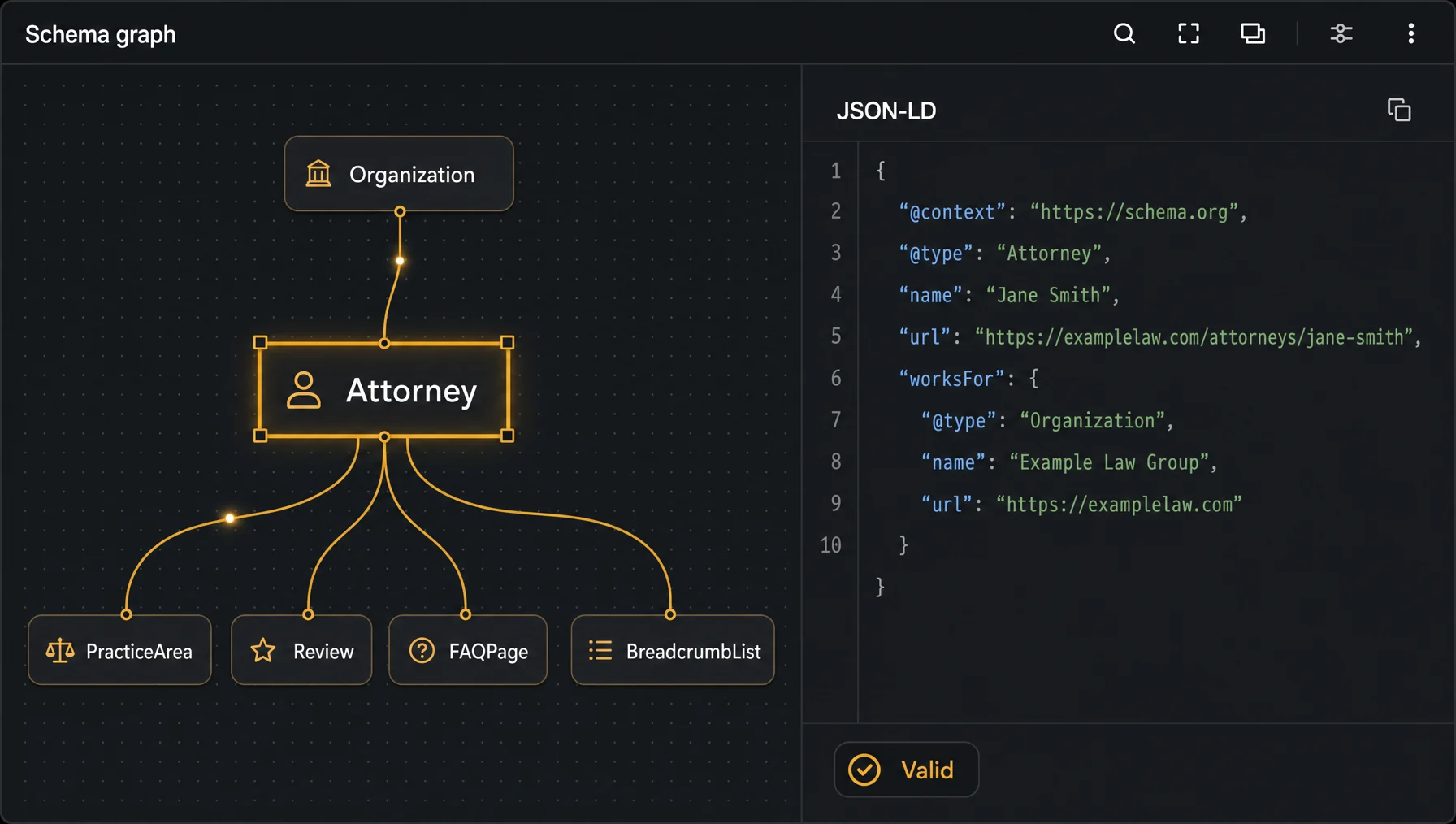
- AI-centric site rebuild About two weeks I rebuild your site with Astro and export all pages as static files.
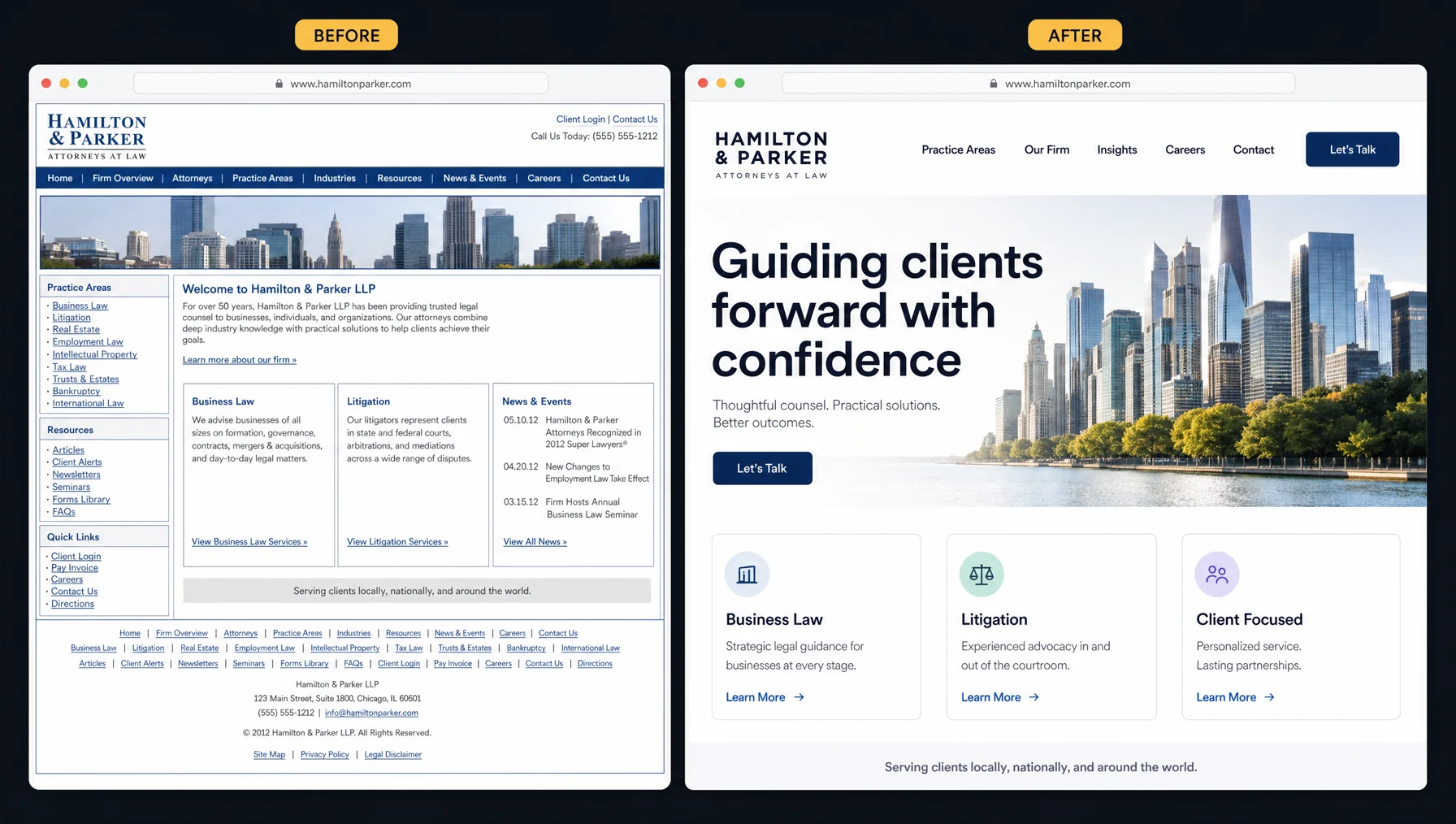
- Schema across every page All pages, one run Every page is a potential rich result.
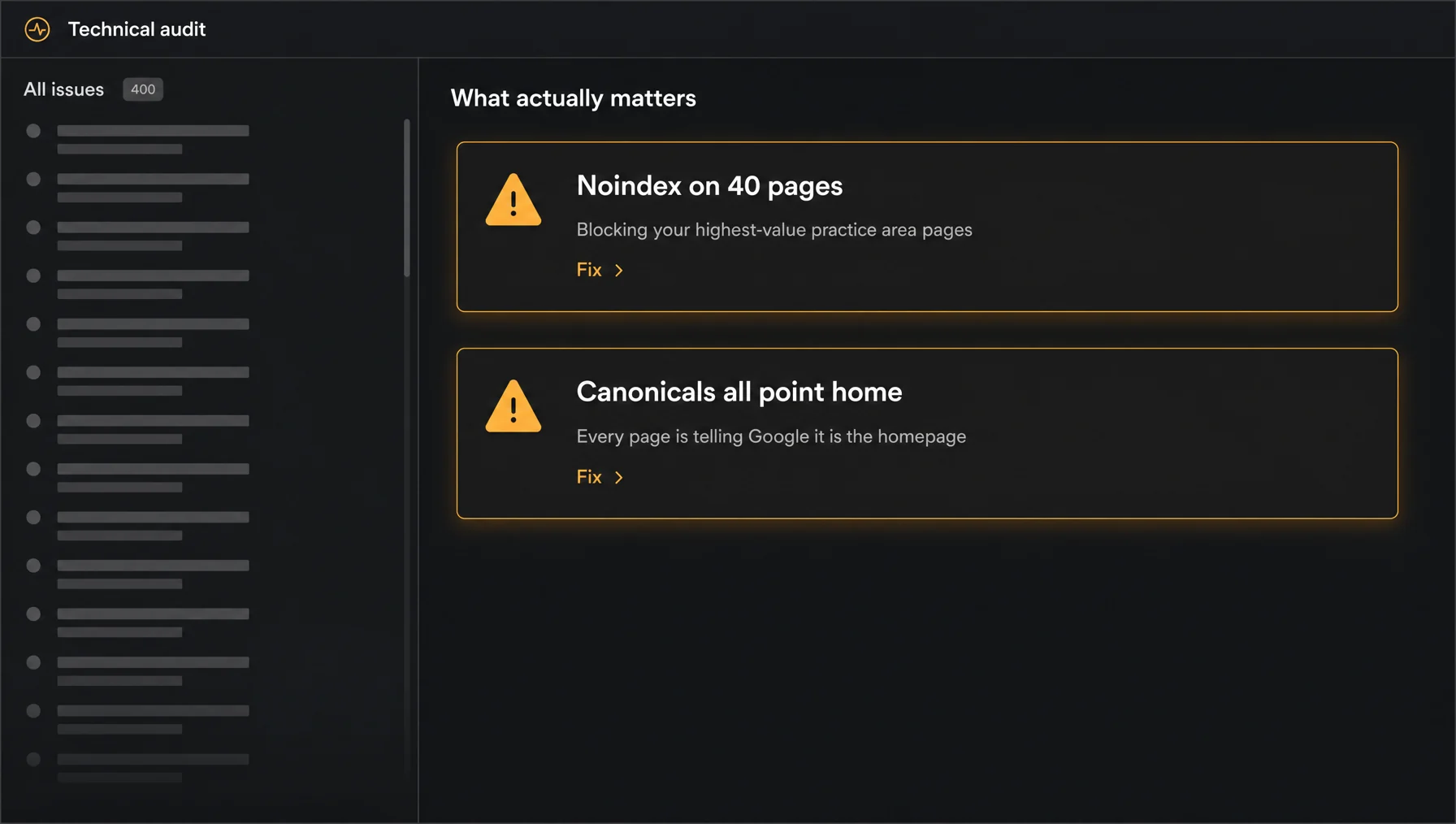
- Technical audit What actually matters Most sites have two real problems, maybe three.
Content
- Human content made with AI Test it yourself above You can always test it yourself above.
- Service and practice page rewrites Pages you already have I like to approach practice pages from the client’s direction.
- Guides built from the evidence Cited, line by line I happily spend weeks reading and citing detailed sources for a single guide.
Authority
- Link outreach No 300% markups I hate resold guest posts and link farm markups.
- Authority you already earned Usually an afternoon Chances are you will have to claim it from sites that already mention you.
- Reviews that keep coming Steady, recent, safe I send one review request to every client who reaches the moment you’ve decided on, including the ones you suspect are unhappy.
Systems
- Measurement that counts cases Signed work, not rankings Most of your inquiries are phone calls, and most reports often can’t see them.
- PPC management Search and Local Services Ads I click through the paid campaigns and notice the wasted spend.
- Business systems built with AI Whatever the business runs on Somebody has to build the dashboards, internal tools and automations.
Pushing what AI can do
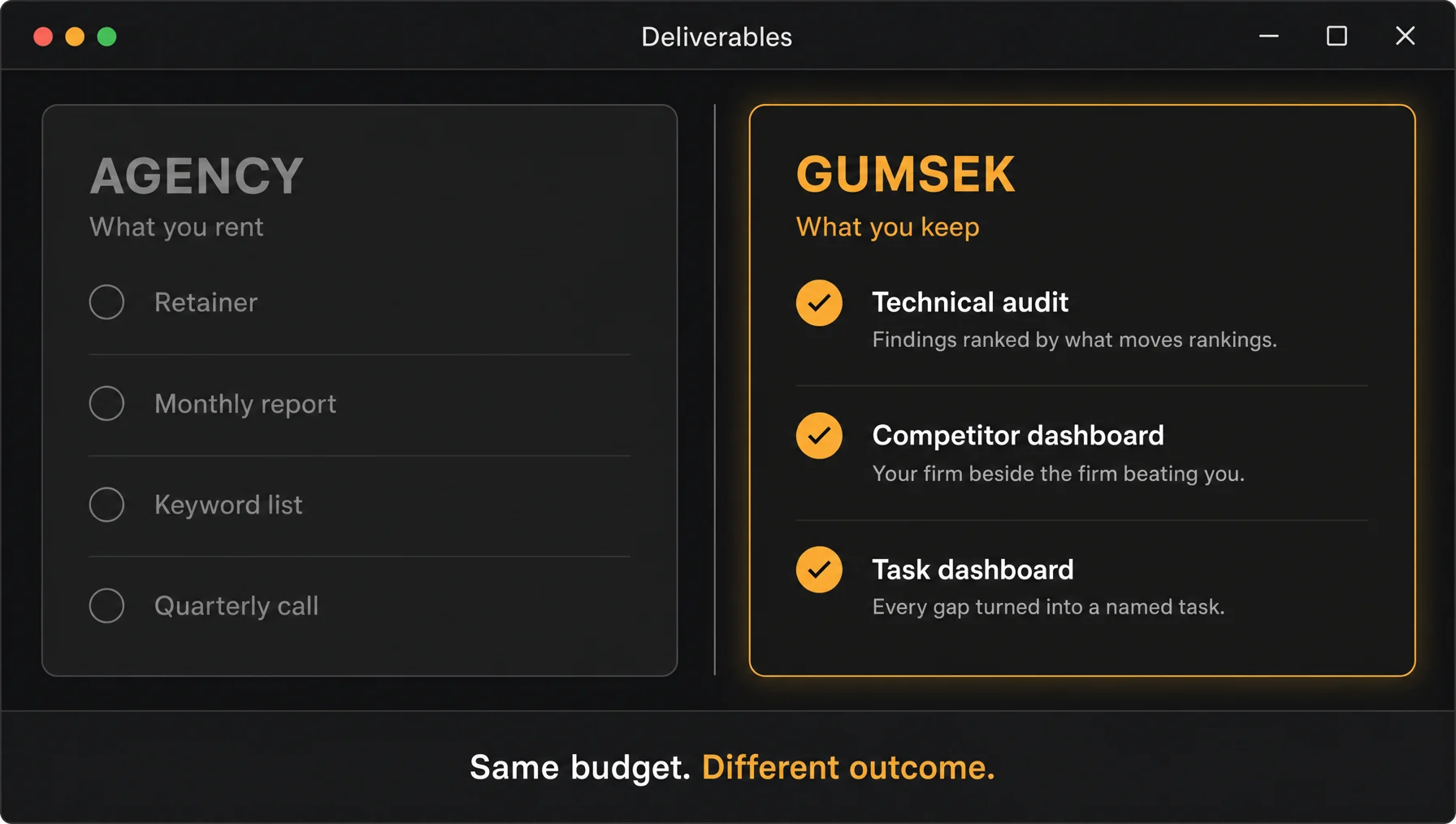
A typical agency will charge you twice the price with a full team on the account and deliver in a quarter. Today one person does the same work for half of the money.
Human, on GPTZero, in every section of the law firm guide I’ve tested.
Documents read in full for the SEO for lawyers guide.
To move a site of any size onto a fast one you can edit by talking to Claude Code.
Person you deal with, from the first call to the finished work.
211 five‑star reviews
Quoted as clients wrote them on Upwork.
He is extremely knowledgeable and honest, and is the real deal in SEO.
Simply the best SEO contractor out there. He helped us out of a tough place. Extremely professional and smart contractor. I can't recommend him enough, top player on Elance. Clean Up Spammy Backlinks (punished by Google)
Jeremy went way above and beyond to help with spammy link disavowal on our company's website. I can't recommend him highly enough. Definitely looking forward to working with Jeremy again! Google Disavow Tool Expert to Remove Spammy Backlinks
Jeremy is amazing! He's very thorough and also quick to respond. I've hired him many times and will continue to. I'm impressed with Jeremy. Create Disavow file for site. Manual Analysis of Spam Links.
Jeremy was really the best person on Upwork for this job. He stuck with me and we got the penalty removed. Need Help Removing a Manual Google Penalty
No agency layer
Show me an agency SEO plan where I can’t deliver twice the work at half the price. Anywhere up to 80% of the cost of an agency plan is agency overhead, and the rest of that is on an outsourced team. I don’t share that agency’s model.
There are no resold guest posts, no upsells. If it’s an ongoing task, I recommend teaching your own team to do the writing or the reporting. Tell me what you pay now.
Tell me your need
Send me your current agency plan, and I’ll send you a cheaper one right back. I’ll let you do the math here. Or write to jeremy@gumsek.com.